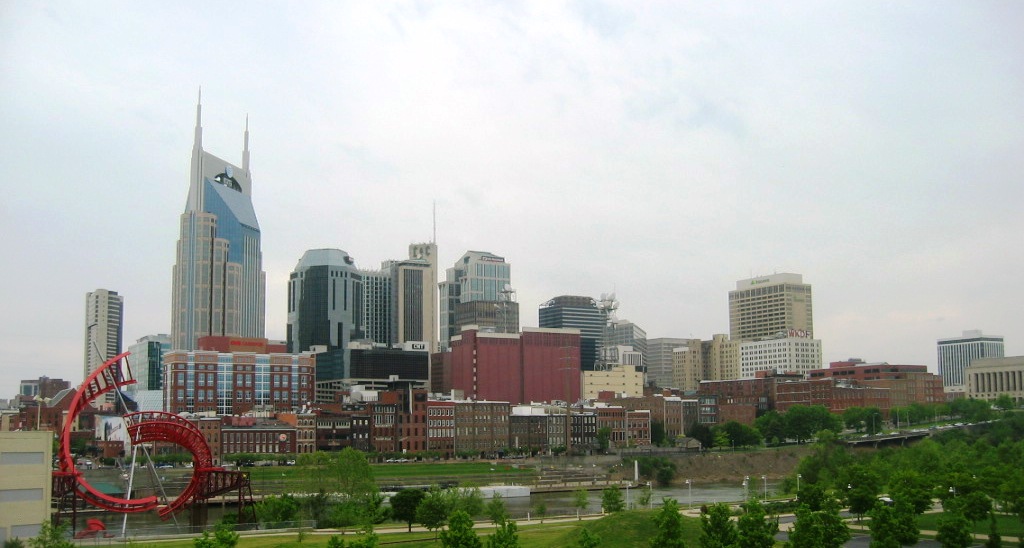
Nashville Lifestyles magazine, September 2013. Cover image copyright Nashville Lifestyles.
—
Last year, Callie Khouri showed America the first city she ever loved. A successful first season and a contemptuous back-and-forth later, Nashville and its creator are back in Music City.
By Scott Latta
With all due respect to the Oscar winner, the Emmy nominees, the Golden Globe contender and the Teen Choice Champ, the biggest star on the set of Nashville is clearly Yoby Britton.
How else to explain it? No one is getting Callie’s attention the way he is. Guy comes into the room and stops the whole show. But, then, duets on the set of Nashville are special things, and Yoby’s picked a good one. On a set that operates with a militant devotion to time and country music, he has broken protocol with a different kind of song.
Connie Britton is one set over, busy becoming Rayna James, and even though her character is the biggest face of ABC’s nighttime country drama, she couldn’t get her director’s attention right now if she wanted to. Her 2-year-old son has already stolen the woman away. Music City built its name on moments like this, on inspired duets brought on by destiny and a simple tune, and so it’s no surprise that here, just minutes from the Opry itself, a soundstage built to replicate everything about the city is replicating what the city does best.
But really all anyone cares about is that Callie Khouri is honest-to-God singing with a 2-year-old. This small-screen showcase of the things that make Nashville famous has paused for its creator to try her own hand. And even though the verse is over fast, those who saw it will say: Academy Award-winning, Nashville-creating, episode-directing Callie Khouri? She still fits right in here, because she’s got the music in her, too. And, at least for a moment, “Itsy Bitsy Spider” was the only song worth singing in Nashville.
So, Callie Khouri is usually asked about two things: her Oscar, and why she always writes women. That happens when you’re the one responsible for sending Thelma and Louise over the side of the Grand Canyon. But before she became known (or, as she might say, pigeonholed) as a Writer Of Strong-Willed Female Characters, the girl from Kentucky was just a college graduate without any idea of what she wanted to do, squeezing the life out of late-night Nashville.
Khouri, now 55, moved to Nashville after college, which at the time was a lot like Los Angeles if Los Angeles had one theater and it closed in 1981. Acting and production opportunities in Nashville were close to nonexistent, so after the Advent Theater shuttered its doors, Callie embraced Music City for its name, waitressing at Exit/In, where she became fast friends with Pam Tillis, and at a bluegrass club called Wind in the Willows.
She didn’t know what she wanted to do here, she says. “But the town was so much fun when I was here. The music was so incredible and stayed with me for so long. It finally made me feel like I needed to do something.” That something, of course, was move to Los Angeles and write the seminal female empowerment movie of the 20th century, make TIME Magazine and win an Academy Award for it, while introducing the world to a guy named Brad Pitt and creating one of the most famous movie endings of all time.
That this road out of Nashville led back to, well, Nashville, might seem surprising, seeing as it was Music City that stalled her career and L.A. that made it. But the film industry changed in the two decades since Thelma & Louise. It’s hard to be optimistic about it now, she says. Fewer movies are made—“anything beside a big comic book franchise or graphic novel” pretty much has to be independently financed, she says—and getting cash for a film is harder than ever.
But Callie still held a city close to her heart, and the feeling that it carried powerful stories. And she still knew one place she could take it.
“I feel like it’s definitely not the golden age of the movies,” she says. “It is, however, a fantastic time in television.”
 After ABC bought Callie’s script in 2011 and production on Nashville began, the show became famous around town for its on-location shoots and insider name-drops. (“We always strived for it to be a show that if you lived in Nashville, you could really hold your head up about it,” she says.) The city’s newest stars had names like Rayna and Juliette and Deacon. Mayor Karl Dean became a tireless cheerleader for the show, and before long the cameras outside The 5 Spot and 12th and Porter led to Gray Line buses that shuttled out-of-town fans around the Nashville they had only seen on Wednesday nights. Callie’s husband, famed music producer T-Bone Burnett, answered the pressure of giving Music City its on-screen soundtrack by loading the show with homegrown talent locals recognized and critics lauded.
Twenty-one episodes later, Nashville was a dependable ratings hit for ABC and a universal treasure for the city. It bought Callie another season, but the city wasn’t so fortunate.
It’s hard for a show to make it past its first year. From 2009-2012, 65 percent of them on network TV didn’t, and in the same period only 39 percent of new shows on ABC received a second season. The odds were against Nashville’s survival, and probably also against its production in Tennessee. First-year costs for a new show are high; each set at the show’s soundstage is constructed with an almost clinical devotion to detail, which requires every builder and painter and electrician that would be needed to rebuild the Bluebird itself. Directors and writers are flown from California to Tennessee when their episodes are filmed, and producers are relocated.
As viewership tapered off from the nearly 9 million people who watched the series premiere, the idea that Los Angeles could pass for Nashville grew from a cost-saving option to a full-on battle for relocation. “As with everything in the Hollywood and L.A. world, dollars are going to drive,” says Butch Spyridon, president of the Nashville Convention and Visitors Bureau. “I never could quite tell if it was ABC or Lionsgate or a combination, but they knew they needed to tighten the budget.”
Nashville had some catching up to do if it was going to keep its second city. For season one the show was able to recoup 32 percent of its production costs in tax credits, but a state law passed since then set a new 25 percent cap. After ABC unsuccessfully lobbied to let Nashville be grandfathered in to the higher cut, it was up to city and state officials to fill the gap if they were going to keep the show and the $40 million in revenue estimated to come with it. The cast showed a near-universal love for Music City—Connie Britton moved here, and “a lot of the L.A. workers have bought houses here,” a producer says—and director after director brought to Nashville fell for the city.
So, in other words, everyone ponied up: the state of Tennessee contributed $12.5 million, Metro government chipped in $500,000, and the CVB and Metro’s Event Marketing Fund each contributed $125,000.
But lest it seem like Nashville was digging in its couch cushions to keep something it couldn’t afford, each side of the table clearly held its own leverage. The city knew production for season two would be more expensive if ABC left; the network knew what the show meant to Nashville’s bottom line.
So, weeks after Rayna and Deacon flipped their SUV into a ditch before the screen cut to black, a second cliffhanger emerged: the city and the network looked across the table at each other, weighing cash against authenticity. And on a Tuesday afternoon in a soundstage north of downtown, that authenticity looks a lot like a trademark Tennessee summer thunderstorm, pounding on the metal roof above, as Callie Khouri washes the spider out with a 2-year-old who turns on the room. Connie will have to walk through the rain to get to her trailer. A producer laughs. “When it rains this loud, sometimes the cameras pick it up,” he says. He is 2,000 miles from home.
There are a lot of reasons why the studio says this show would work better in L.A., and 40 million why the city says it works better here. But to the woman at the heart of it, there was always really just one.
“This city feels different than any other place we’d find to shoot,” Callie says. “This is a city that really has a soul.”
She is the mayor of this place, tracking through its model-home sets in a blue dress shirt and black suit with an intentionality that sets the curve everyone else will follow. The soundstage is a hangar-like cavern of impossibility. Bars back up to living rooms; hallways and staircases lead to nowhere. The entire place is a labyrinth of homes and shops and cityscapes beneath false ceilings and drop lights. A guy could walk out of the Bluebird and right into a Brentwood kitchen if he didn’t know where he was going.
Callie traces its paths with a confident sense of familiarity. It takes around 120 people eight days of 12-hour work to produce an episode of Nashville, but beyond the simple arithmetic of the job is a sense that everyone on set, from the writers to the carpenters to the actors and their dead-ringer stand-ins, just enjoys being there. And really they’re all just following the lead of the same woman. This idea of city as character starts with her, because in this soundstage puzzle of a town that doesn’t make sense, Callie is in the middle of a city she knows.
It all seems so…well, Hollywood. And that was Callie’s whole idea, really, to show America the glam Music City’s insiders already knew the place had. Rayna James and Juliette Barnes and Scarlett O’Connor are not fictional; they’ve existed here since lower-Broad buskers first filled the air with the pluck-picking of heartbreak. They were here when Callie Khouri was here thirty years ago, at the Exit/In and Wind in the Willows. And they always will be, on street corners and white-lit stages from Tootsie’s to 3rd and Lindsley. Everyone in Nashville has heard Rayna James, because most of us are Rayna James, at least in our dreams.
Something would have been lost if production had moved to L.A. The Nashvillians on the show know that, even if Seinfeld and Cheers and countless others told their cities’ stories from a studio lot in Burbank. Nashville just needed Nashville. “It’s strange, because for people in Nashville we all know we’re talking about the same person when we talk about the city,” Callie says. “It’s a hard thing to describe.
“You have to be from here to show people how to look at it.”
For another year, they will be. The city and its advocates, from Karl Dean to Butch Spyridon to Callie Khouri, fought hard for that right, so that the crowds who gather at the Bluebird on Tuesday afternoons, posing by the door to take their piece of the city back home with them, can feel they’ve really been shown the place when they see it on Wednesday nights. That was the Nashville Callie had in mind at the beginning. That is what she means when she says Nashville is a city with a soul—this show, this once-a-week look at the place she first regarded as a honky-tonk waitress, is nothing if it’s not true to its own subject.
“Say it with me, Yoby,” she says. Then she calls it: Action, and with one word Nashville’s second city falls into a heavy silence. “Action” is the currency of the studio, the word that breathes life, scene to scene, set to set, with a weight that measures the breaths of the crew. It’s the only word here that locks doors. It flicks on swirling red lights that flash through the building and sends producers running like linebackers before a snap, then freezes them like the grass. And when Callie calls it, she calls along with it a deeply respectful vigil to the scene at play. No one dares break that. Until someone does.
“Action,” he calls back. Callie turns to laugh, smiling at Yoby with her eyes, then cuts back to her monitor as the set falls silent again. “That’s right,” someone says, and their last duet has ended, so another can begin.


You must be logged in to post a comment.